
Prepping at a glance
- Compare watt-hours as well as advertised milliamp-hours.
- Verify charging protocols and cable compatibility.
- Inspect and maintain the battery according to its manual.
Define the charging job
The best power bank for emergencies is not automatically the largest model. List the devices you need to keep operating and decide which are essential. A phone used for brief check-ins has a different energy budget from a tablet playing video all evening. Include the charging needs of hearing devices or other personal electronics, and obtain provider guidance for medical equipment.
Decide whether the emergency phone charger must fit in a pocket, remain in a household kit or support travel. Weight and storage conditions can make a high-capacity unit inconvenient enough that it is left behind. Start with a realistic daily routine, then compare batteries that fit it.
Read the energy and output labels
Power bank watt hours provide an energy measure, while watts describe charging power. Milliamp-hour figures are meaningful only with the voltage used for that rating. Do not compare a bank's cell-level milliamp-hours directly with a device battery and assume an exact number of full charges; voltage conversion and losses complicate that shortcut.
Check the output connector, supported charging standards and wattage your device accepts. A compatible-looking USB port does not guarantee the speed you expect. Read the combined output limit when several devices charge together. For air travel, consult FAA: airline passengers and batteries and the airline's current rules; power banks are subject to specific lithium-battery carriage restrictions, and household backup equipment is not automatically suitable for a flight.
Test a complete charging cycle
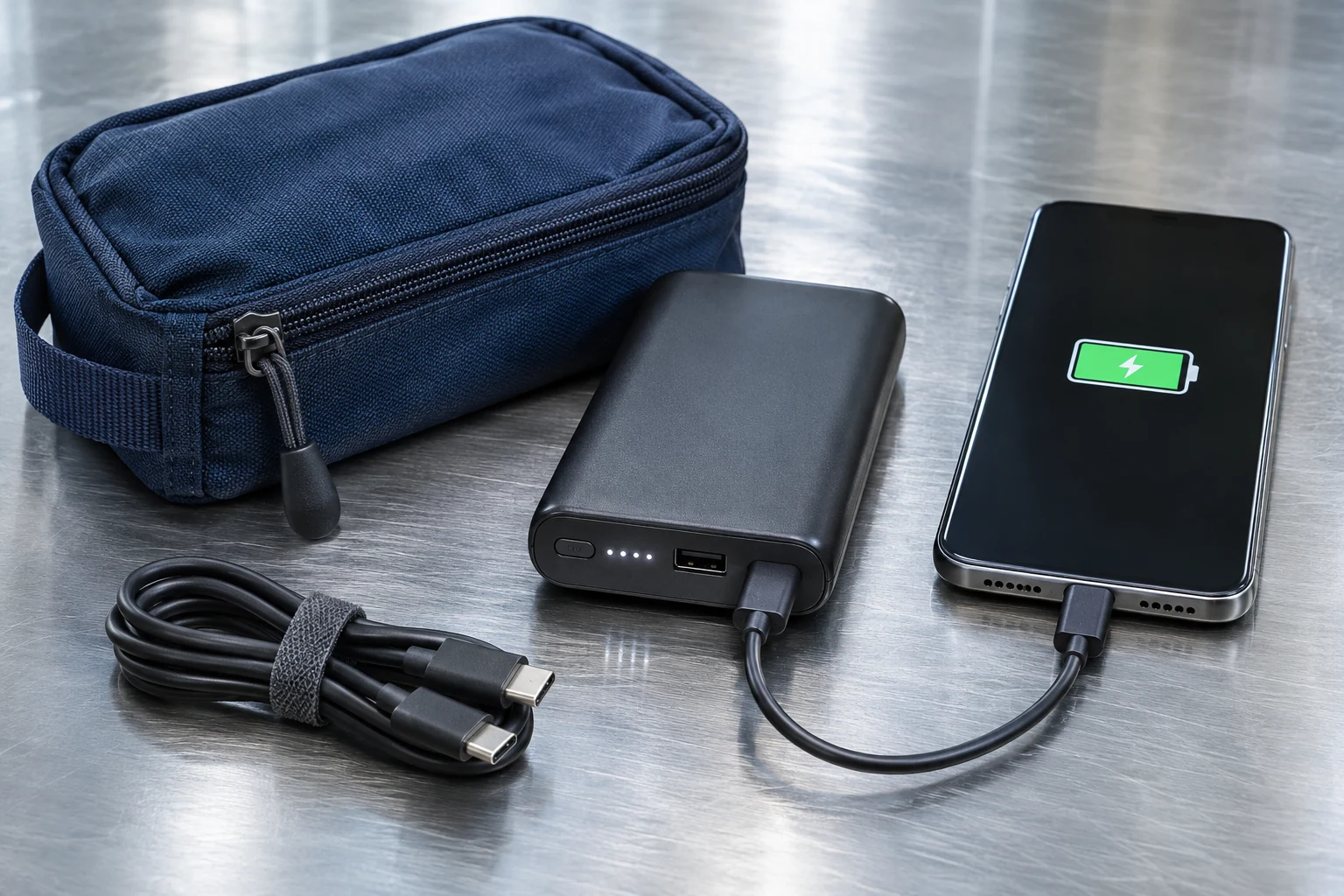
Use the cable you plan to store with the bank, including any adapter and the phone's usual case. Charge a device from a known level and note how much the bank's indicator changes. This is a practical check, not a laboratory capacity test. Repeat with a second critical device if the household relies on more than one connector.
Also test how the bank itself recharges. Record the wall adapter and approximate time needed under your normal conditions. A large battery that takes an unexpectedly long time to refill may not suit short opportunities to charge. Avoid assuming pass-through charging is supported; check the model's documentation before trying to charge the bank and a device simultaneously.
Store for readiness, not neglect
Follow the manufacturer's temperature and charge-level storage instructions. Inspect the case and ports regularly, and stop using a unit that is swollen, damaged, unusually hot or otherwise abnormal. Seek the manufacturer's guidance and appropriate local battery recycling or disposal options; do not put a damaged battery back in the kit because its display still lights.
Put a label on the pouch with the model, cable type and review date. Rotate the bank into occasional ordinary use so its operation remains familiar. During an outage, set household charging priorities and reduce nonessential use before the reserve becomes low. Two compatible cables and a sensible charging plan may improve readiness more than another battery bought without a defined role.
