
Prepping at a glance
- Match each knot to a defined low-risk task.
- Practice dressing, setting and untying it.
- Keep these exercises separate from life-safety rigging.
Choose five distinct jobs
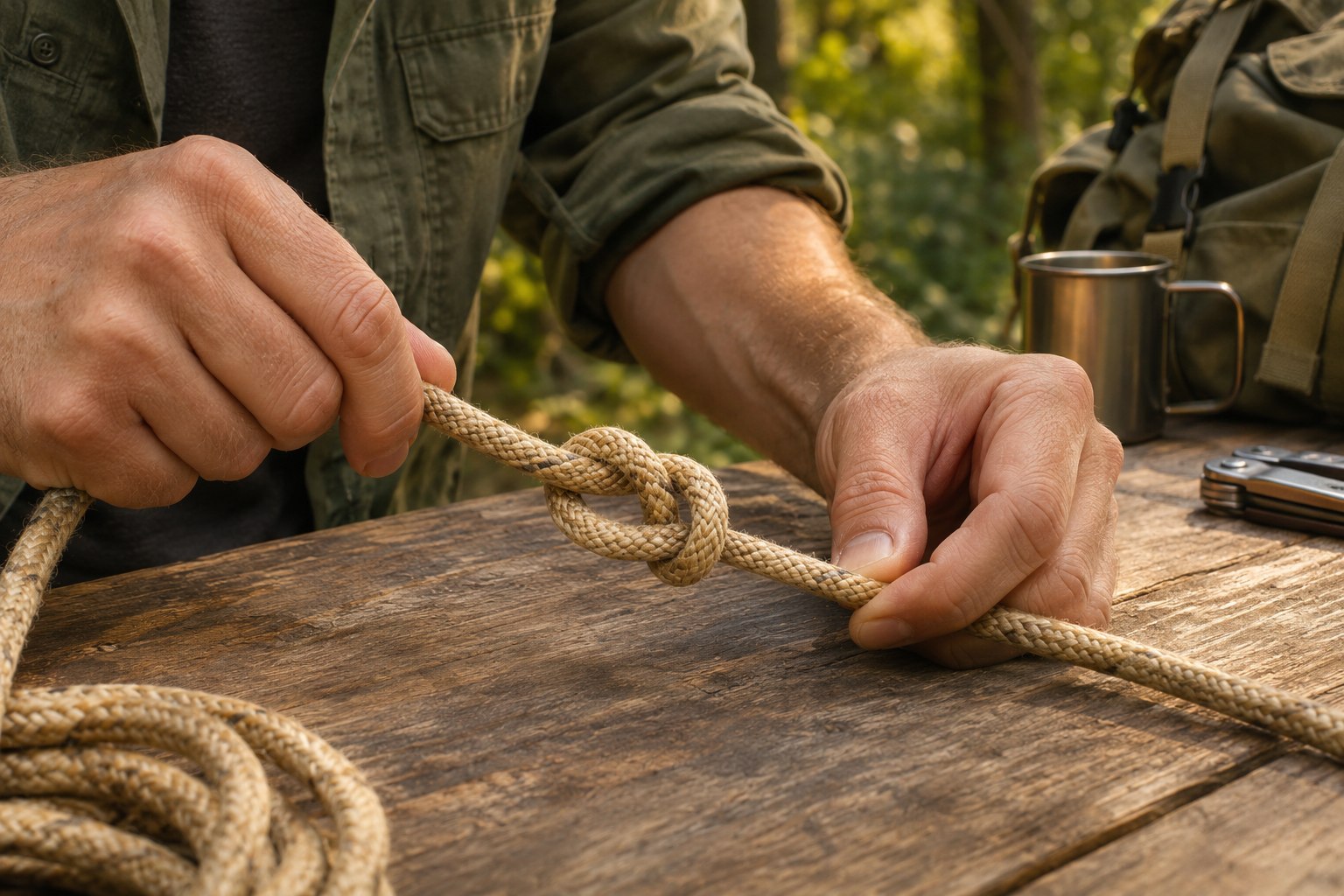
Basic survival knots are easiest to remember when each has a job. Start with a square knot for binding an ordinary bundle, two half hitches for securing a line around a suitable object, a bowline for a fixed loop, a sheet bend for joining suitable cord and a taut-line hitch for an adjustable camping line. Scouting America: basic knots provides illustrated instruction for these common knots.
This article is a practice plan, not a complete visual tying lesson. Use a reliable diagram or qualified instructor and compare the finished structure carefully. Do not use a short general article to rig climbing systems, rescue loads, suspended people or other life-safety applications.
Practice the first two with a simple prop
For camping knot practice, use soft cord in an easily visible color and a stable low-height prop. Tie the square knot around a harmless bundle, then inspect it against the diagram. It is a binding knot, not a universal way to join ropes under load. Notice how a similar-looking mistake changes the structure.
Next, practice two half hitches around the prop. Dress the knot neatly, set it with a light hand pull and untie it. Repeat from a different position so the skill does not depend on memorizing one camera angle. Keep fingers clear of tightening loops and avoid tying around a person or animal.
Add loops, joins and adjustment
Practice a bowline's fixed loop around a small noncritical object, checking the finished form with the reference. Then learn a sheet bend using suitable cords and confirm the orientation rather than assuming any two ends can be tied the same way. Cord material, diameter and surface condition can affect behavior, so do not transfer confidence automatically to unfamiliar rope.
Knots for tarp guylines should be practiced on the actual cord you intend to use. A taut-line hitch offers adjustment in appropriate conditions, but it is not guaranteed to grip every slick modern cord. If the manufacturer recommends different hardware or a particular knot, follow that guidance and test the ordinary camping setup at low risk.
Check, repeat and know the limits
For each knot, say its purpose aloud, tie it without rushing, compare it with the diagram and apply a gentle appropriate check. Then untie it and explain a situation where it should not be used. Store a small illustrated reference with the cord so another household member can learn the same method.
Repeat brief sessions over several days rather than trying to memorize everything once. Practice in good light before adding mild distractions or gloves. Inspect cord for wear and retire damaged material from use according to its purpose. The goal is dependable handling of ordinary camp and household tasks, with enough judgment to recognize when rated equipment, a different method or qualified instruction is required.
