
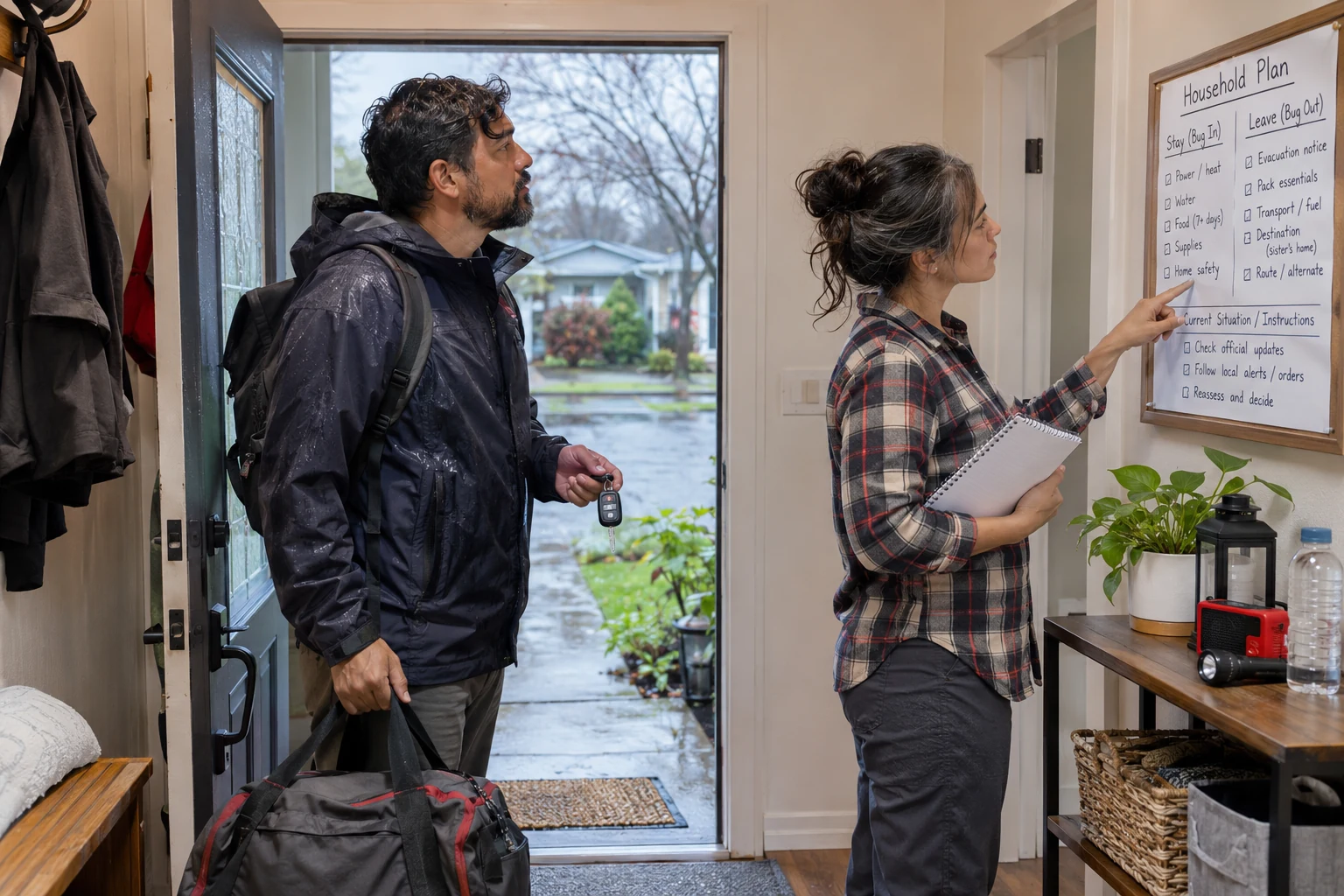
Prepping at a glance
- Official protective instructions come first.
- Prepare for staying and leaving.
- Choose destinations and transport before a crisis.
Replace the slogan with a decision
The bug in vs bug out debate is useful only when it leads to a safer household decision. Staying home may be appropriate during one event and dangerous during another. A well-stocked pantry does not make a building safe from fire, flooding, or another immediate threat.
Begin with instructions from the authorities responsible for the incident. An evacuation order and a direction to shelter in place call for different actions. Conditions can change, and a general article cannot determine the correct protective action for a specific unfolding emergency.
Understand what staying requires
Ask whether the building remains safe and whether essential needs can be met. Consider access to water, appropriate temperature, sanitation, medication, and any equipment that depends on power. Some of these needs require arrangements with clinicians, equipment providers, landlords, or utilities well before a disruption begins.
Shelter in place has hazard-specific meanings; do not treat it as a universal instruction to seal every room or remain indefinitely. Learn the relevant local guidance for the hazards in your assessment. Keep a way to receive updated instructions and identify the circumstances that would require contacting emergency services.
Make leaving a complete plan
An emergency evacuation plan needs a destination, a transport method, and an alternative for each. A bag by the door is only one component. Confirm where people, pets, mobility aids, and essential supplies can go, and check whether the arrangement still works when roads or services are disrupted.
Think through the hour before departure. Who helps whom? Where are important documents? Can the bag be carried without blocking needed mobility support? Keep preparations brief enough that they do not delay an urgent departure. Never re-enter an unsafe building to finish packing or collect a forgotten object.
Discuss decision triggers calmly
Write down the information that would prompt action: official orders, a direct threat to the building, loss of a critical support service, or another circumstance identified with a qualified provider. Distinguish these triggers from rumors and general anxiety. The plan should explain who checks official updates and how others are informed.
Use a hypothetical example: the home is intact, but a dependent household member's essential support cannot continue through a lengthy outage. That family's backup arrangement may require an earlier move than a neighbor's. This is why a universal stay-or-leave rule cannot replace individual planning.
Rehearse both branches
For the stay-home branch, locate supplies and instructions without shutting down utilities. For the departure branch, gather the portable items, check their weight, and talk through transport. Review the Red Cross household planning guide to connect these arrangements with contacts and meeting locations.
After the walkthrough, identify the weakest assumption. Perhaps the destination has not agreed, the carrier is too small, or the only driver is usually away. Fix that assumption before expanding the bag. Preparation should give you workable choices while leaving room to follow the actual conditions and official directions on the day.
